


The Secret Weapon Historical Authors Use Is a 'Nonprofit Library for the Intellectually Curious' — and You Can Use It, Too

Every public library offers access to its archives and databases. For most libraries, that yields a comprehensive view for its members into the past, dating back to the 17th century, when you access the JSTOR archive.

From overcrowded stacks to a new model for access
What makes JSTOR such a valuable research tool?
JSTOR evolved from library books and journals. Collections of images, rare books, primary source documents, ephemera, and other content from partner institutions, are shared in digital formats on JSTOR. (JSTOR is short for Journal Storage.)
The JSTOR archive provides access to academic journals in the social sciences, humanities and sciences. It's an excellent resource for primary source documents dating back to the seventeenth century.
What about images, maps, multi-media?
You'll find collections of high-quality images, curated from leading museums and archives around the world in the adjacent ARTSTOR archive. Millions of curated, cross-disciplinary, rights-cleared images and multimedia are discoverable alongside JSTOR’s journals, books, and other primary sources.
JSTOR is "the nonprofit library for the intellectually curious"
Here's how I've used JSTOR and its art companion, ARTSTOR
I've spent over a dozen years researching Texas and 20th-Century US history. I've dedicated a good deal of that time sourcing original articles that reflect the attitudes of their times, and first-person accounts of historic events, plus supporting media. Journal pieces and headline stories that are long out-of-print can be found there. These contributions give me a sense of how people thought and spoke in past times.

JSTOR was my daily writing partner when I researched history for The Dust Series
In writing The Dust Series novels, set in Texas ca 1930s onward, it was critical to making my characters as real as fictional people get—by understanding how the language people used, and what mattered to them. I found excellent resources on terminology, common figures of speech, timely topics, and regional slang in the JSTOR archive.
Consider some of these key sources, with real-life examples:
A Glossary of Railroad Terms, 1943 from American Speech: a reefer meant a refrigerator car; a highball signaled a clear track; the train cook was called a lizard scorcher. Railroad terminology like this was essential in crafting realistic characters in The Dust Series books.
Modern Slang, 1936 from American Speech: a Benjamin, shortened to a benny, referred to a coat; and a devil dodger was a clergyman. Peppered into a character's speech, authentic slang brings an era to life.
Ranch Diction of the Texas Panhandle, 1933 from American Speech: To burn the breeze was to go at full speed; a John B. was a Stetson hat; a brain tablet meant a cigarette. I wove 1930s-era lingo like this into the fabric of Unspoken: Secrets and Survival in the Texas Dust Bowl, Book One of The Dust Series.
Grass to Dust: The Great Plains in the 1930s, 1976 from Environmental Review: In an article I relied for historical details in Unspoken: Secrets and Survival in the Texas Dust Bowl, Book One of The Dust Series, historian Donald Worster opened his essay explaining the devastation of the Dust Bowl with this visual and description:

The Drought of 1988, the Global Warming Experiment, and Its Challenge to Irrigation in the Old Dust Bowl Region, 1992 from Agricultural History: Author John Opie tackles on-going droughts and greenhouse gases in one quote from a Plains insurance agent, "Farmers aren't buying anything but crop insurance."
Western American Literature, 1974 reviews the classic Texas book about the 1950s Drought of Record, The Time It Never Rained by Elmer Kelton. That book became an important source in my historical presentation, The Hidden History of The Texas Dust Bowl.
The Pecan Shellers of San Antonio and Mechanization, 1965 from The Southwestern Historical Quarterly provided background and details for a scene I wrote in Overdue: Riding the Rails Across Texas in Hard Times, Book 3 in The Dust Series (May 2027).
Uncovering period articles has become de rigeur as I write my novels in The Dust Series, because I always aim to write characters who are as true as fiction gets. And the tidbits I find become prized material for my historical presentations to groups, too.

My own historical library could use a JSTOR, too
Ready to get started using JSTOR? Start at your library.
Log in to your public library account, and search the main categories (such as references, resources, databases) or search for JSTOR. While you can create a JSTOR account directly, you'll get free access using your own library.
Similarly, if you happen upon a scholarly article you'd like to read, as you might when checking references on Wikipedia or in books' bibliographies, you might find you are locked out of the sponsoring institution. It's worth searching the article's exact title in your library's JSTOR database—I've gotten access to most of the academic or journal articles I've searched there. Their format as downloadable PDFs makes the articles easy to save and read offline, too.
There's an even easier way to get started with JSTOR.
Subscribe to The Daily from JSTOR, 'the nonprofit library for the intellectually curious,' for a fascinating mix of articles delivered right to your inbox. Today's newsletter shares "How the Phone Book Taught America to Ask Questions" It turns out that a collection of Texas directories from 1913 to 1959 (located down the road from me at Southwestern University) shows how phone books—and the people who used them—helped invent the “information age."
Or visit the rotating Collections on JSTOR for random images, rare books, primary source documents, ephemera, and other content from partner institutions adapted into interesting posts with images. Just a smattering of the many features today include:

The JSTOR visual identity was crafted by designer Michael Mabry, who proposed the iconic floral “J” as a deliberate nod to the history of print, drawing inspiration from decorative initials used in Renaissance-era typesetting.
Thirty years later, JSTOR is a robust digital platform for research, teaching, and learning—including advanced discovery, research management, and teaching tools.
—source: JSTOR
30 years of JSTOR: How a library shelf crisis sparked a global archive
What if the journals didn’t need to be stored on-site at all? —William G. Bowen
The idea for JSTOR took shape in late 1993, during a routine board meeting at Denison University. William G. Bowen, then president of the Mellon Foundation and a trustee at Denison, was evaluating a proposal to expand the campus library to make room for more journals. Instead of focusing on funding for new shelves, Bowen posed a bolder question: What if the journals didn’t need to be stored on-site at all?
At the time, the first web browsers were just emerging. Bowen proposed digitizing the full backfiles of academic journals and making them widely accessible online. This was suggested as a scalable solution to help relieve the overwhelming pressure on libraries, while also securing long-term access to interdisciplinary scholarship.
JSTOR evolved into a pilot project to digitize core journals in economics and history. Economics and history were selected as disciplines for the pilot because they were widely taught, had strong nonprofit publisher support, and offered contrasting research and technical challenges. This would demonstrate the archive’s potential to serve interdisciplinary needs across a range of institutions. —JSTOR Blog

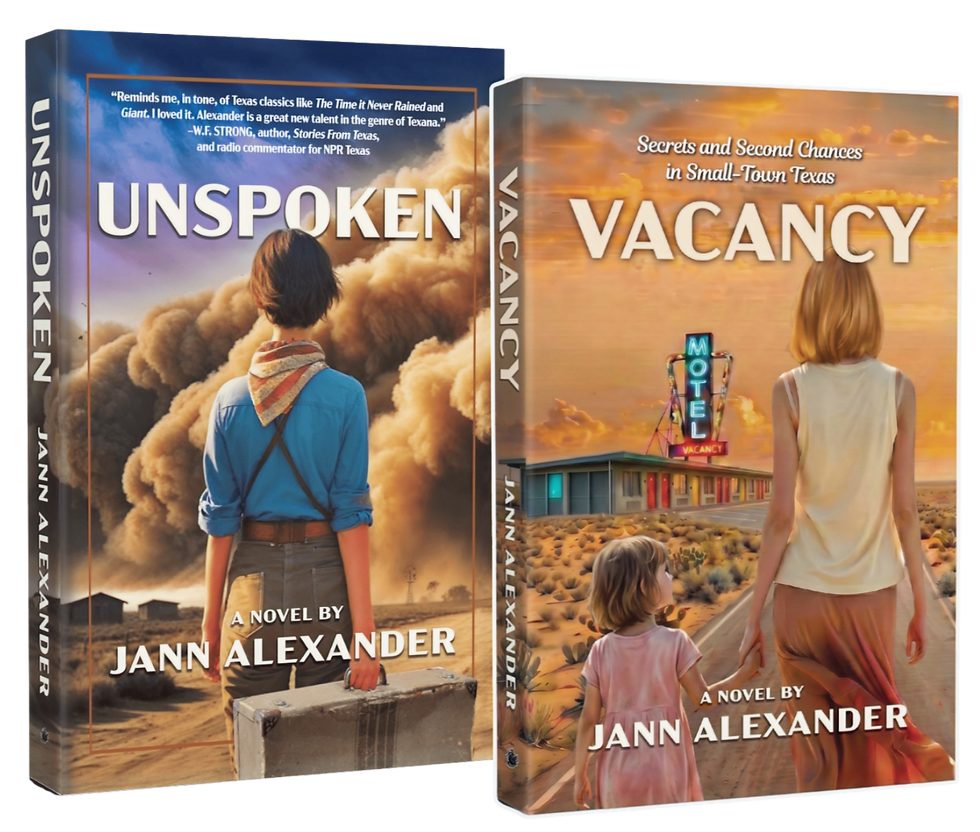
JANN ALEXANDER writes characters who face down their fears, in novels as true as fiction gets. She is the author of THE DUST SERIES, including the best-selling historical novel, UNSPOKEN, set in the Texas Panhandle during the Dust Bowl and Great Depression eras, her first book in the series. With a dozen years of research into Texas, she’s also a speaker on its hidden histories. Her second novel in The Dust Series, VACANCY, is fictionalized true crime with second-chance romance. Her third Dust Series novel, OVERDUE, releases in May 2027. Jann always brakes for historical markers.


Comments