


Jann Alexander speaks with WriterAdvice.com on inspiration, writing visually, and handling tough characters facing hard truths

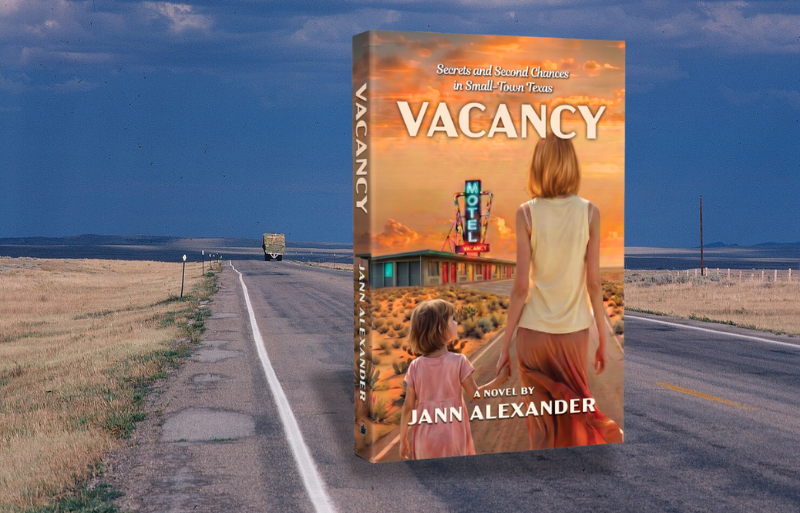
Vacancy is inspired by real events. A struggling single mother and a suspicious widow both have a habit of hiding from hard truths, until a tragedy no one sees coming forces them to face what they’re hiding—and fill the vacancy in their own hearts.

Jann Alexander is interviewed by Lynn Goodwin, editor and author at WriterAdvice.com
BLG: How did you get started as a writer? Do you remember when you were first published and how it felt?
JA: I started writing as a child and in eighth grade I published my first book, Eric and the Smugglers. I typeset it on my dad’s Underwood typewriter, illustrated it with my set of color pencils, and saddle-stitched it with my dad’s mega stapler. Thereafter I moved in the direction of journalism and design and never gave any thought to being a published author until I retired early in the D.C. area, and relocated to Texas, in 2004.
Blogging was my preferred form of writing for many years, and it was the perfect training for writing books: in a short amount of time, you make your case, explain your logic by enumerating your reasons, and you get to the point pretty quick and you use art or photos to support your idea—not unlike a novel, except you have a longer timeframe to tell a story. I still blog today at Pairings, where I pair the many aspects of creativity.
BLG: Tell us how two newspaper stories inspired Vacancy: Secrets and Second Chances in Small-Town Texas. What was the starting point?
JA: In 2005, two articles on the front page of a major newspaper’s Metro section jumped out. One story was joyful, the other horrific, and the characters in each were unrelated. But I wanted to understand how the horrific tragedy could have occurred, and why the joyful serendipitous romance happened. I was inspired to meld them together into one novel, to explore the complexities and what-ifs of each situation. I chose the Texas Panhandle setting for its small-town environment, where scenarios of secrets and second chances, and tragedies nobody sees coming, would be believable.
BLG: How did you expand, adapt, and alter the newspaper stories to turn this into a novel?
JA: I started with the actual known facts and began asking myself questions. I learned everything I could about the two situations. I parsed the smallest details of every news article or quote, and learned about each person involved. I tracked down not just names and locations, but visual details, ages, personal histories, work and recreation habits, their manner of speaking, where they live, their town’s personality and weather, anything that would help me reimagine the true stories. I use the same techniques when I write historical fiction, such as my first novel in The Dust Series, Unspoken: Secrets and Survival in the Texas Dust Bowl.
Of course, when I was ready to write, that’s also how I put the reader in the midst of the action, feeling the emotions the actual people must have felt—before, during, after. And I relied upon my own emotions from joyous and tragic experiences. As a writer, it’s helpful to be an observer of how people react, and to wonder why—two of my lifelong habits.
BLG: What do you hope readers will take from Vacancy?
JA: As I researched the origins of Vacancy, I noted the judgmental nature of the small-town residents who were angered by the tragedy. As I wrote the book, I understood there could be many interpretations of what happened, and many reasons behind it. In writing Vacancy, I revealed these tidbits along the way, hoping readers decide that most situations are not black and white—allowing grace to people facing trauma, with compassion and understanding. Readers love fiction for its commonality with events in their own lives, and Vacancy won’t disappoint.
"My eyes are like a camera that’s constantly clicking and recording, and I study everything around me in a new, or familiar place I go. It’s a game I play, absorbing all the details." —Jann Alexander, author, The Dust Series
BLG: You have some very descriptive passages even though parts of Texas can be bleak. What tips can you offer for bringing description to life?
JA: My most important piece of advice is to think visually. How do you do that? Because I was an art director, photographer, and painter before I turned to writing novels, my visual sense was already honed. When I visualize a scene I’m writing, I think cinematically.
If you’re not already observing the big picture and the smallest of details, begin to make it a habit. Take photographs (not just snapshots) that require you properly frame a subject, and to consider the best lighting. That habit also trains you to see the details and think visually.
My eyes are like a camera that’s constantly clicking and recording, and I study everything around me in a new, or familiar place I go. It’s a game I play, absorbing all the details. And when I am writing, I research, which involves my images, and lots of old photographs, and old maps, even film footage. Then I can visualize what I’m putting words to.

A struggling single mother and a suspicious widow, at odds.
Both have a habit of hiding from hard truths.
BLG: I know this is your second book with Black Rose Writing. How did you find them, and did you use one of their editors before submitting? If so, how did they help you?
JA: It’s fitting I found an independent press in a small Texas town to publish The Dust Series, because my books are set in a small Texas town in the Panhandle. I always work with a developmental editor I trust, and a skilled copy editor (both in Texas) before submitting a manuscript, and get another eye on it from the publisher’s editor and the publisher himself. My publisher excels at marketing and promoting, and offering opportunities to its authors we could not easily secure for ourselves. And the Black Rose Writing author community is a huge bonus of supportive, knowledgeable writers.
BLG: How did the company help you with publication and marketing and what did they leave up to you?
JA: I submit what I consider a polished manuscript, having gone through a few rounds with my own editing team, and await feedback from my publisher. It’s a great process that ensures my novel is as tight and accurate as possible. My publisher assesses my book’s market potential, positioning, comps, Amazon categories, and provides an excellent marketing backbone for my book. The design team works with me to achieve the best results for covers I have suggested, and handles the typesetting with flexibility for my corrections. The publisher is responsible for the backend submission to Ingram, Amazon, other booksellers, and makes it possible for me to track sales, run ad campaigns, secure BookBub deals and whatever it takes to sell my books. I’m responsible for doing my own personal promotion, which involves launching my book, working with book clubs, speaking to groups, being on podcasts, submitting articles, creating social media and a book trailer.
"No character is completely irredeemable (in my books)—and the reader should sense an inkling about an awful character’s potential for good, even if it’s not evident by the book’s end." —Jann Alexander, author, The Dust Series
BLG: I care about all your characters except Ray. I think you want it that way. What’s the best tip you can give to writers about creating believable, three-dimensional characters?
JA: Believable characters are flawed, like every human I have ever known, and some have more good qualities than bad. Some characters have a few redeeming qualities that outweigh their many blind spots. Others are more flawed and unlikeable. Keeping that balance is the author’s job. But no character is completely irredeemable (in my books)—and the reader should sense an inkling about an awful character’s potential for good, even if it’s not evident by the book’s end.
BLG: What are you working on now and where can readers learn more about you?
JA: While I’m doing final edits for my third novel in The Dust Series, called Overdue: Riding the Rails Across Texas in Hard Times. In the Texas Dust Bowl, fourteen-year-old Will Becker sets out for home but keeps riding the rails, chasing education, work, and a way to save his family farm—until history turns every detour into a reckoning. Overdue will release in May 2027.
Vacancy launched with a celebratory party, book blog tours, podcasts, interviews, social media, and more. And I’m mulling over the plot of the fourth book in The Dust Series, still just a glimmer in my mind.
Reach me at my website JannAlexander.com where you can read my free short story, Homeless, when you subscribe to Pairings, my monthly newsletter of book perks and creativity. You can arrange for me to speak to your group in person or by Zoom, on topics like “Hidden History of the Texas Dust Bowl,” and “The Women Behind the New Deal,” all developed from a dozen years of historical research I did to write The Dust Series. I also love speaking with book clubs, and I’m active on social media, because I like to share.
—This interview first appeared in WriterAdvice.com, 11.15.2026


INSPIRED BY REAL EVENTS
Vacancy - Secrets and Second Chances in Small-Town Texas releases September 24, 2026.
Order Vacancy from the author HERE, autographed and personalized with your name
Shop for the ebook, paperback, audio on Amazon HERE
READ MORE reviews of Vacancy on GOODREADS
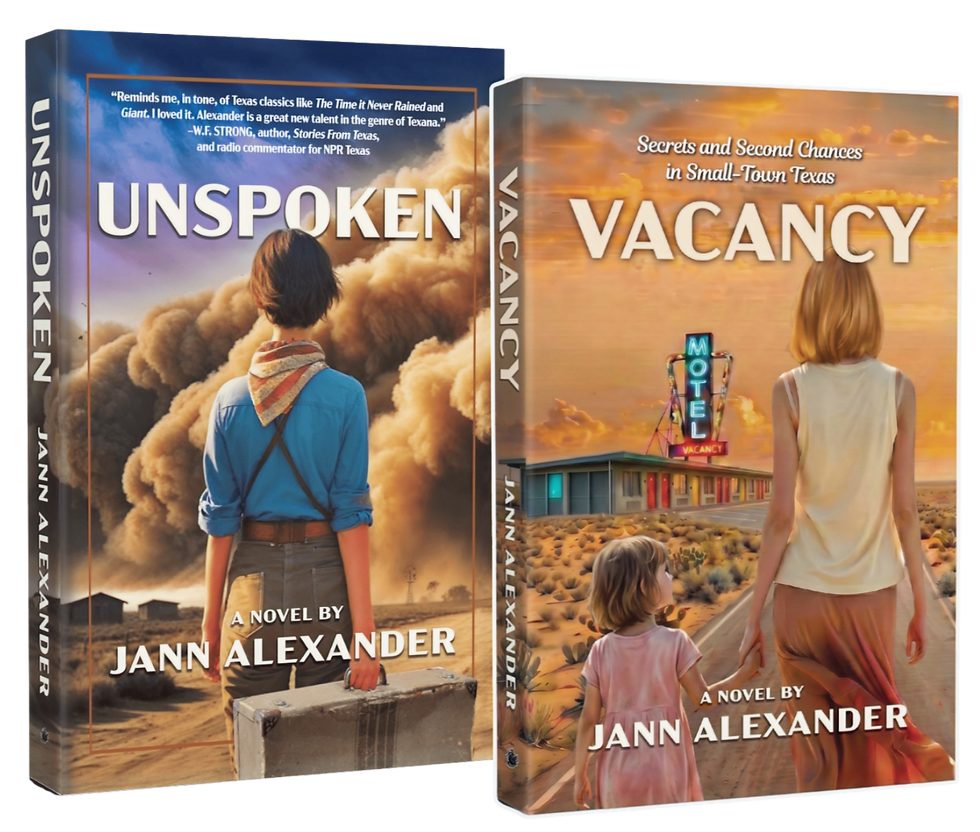
VACANCY: SECRETS AND SECOND CHANCES IN SMALL-TOWN TEXAS,
IS THE SECOND NOVEL IN THE DUST SERIES.
READ UNSPOKEN: Secrets and Survival in the Texas Dust Bowl, Book One
About Vacancy
THE SECOND NOVEL IN THE DUST SERIES
Helen is childless and widowed after a long marriage and gets a second chance with a long-lost love. But she’s grieving her hidden regrets. She bonds with her quiet kindergarten student and doubts the girl’s struggling single mother, Charlene, is fit to parent.
Charlene’s hiding a secret of her own, and she resents Helen’s interference. She’s determined to make a better life for her young daughter, the teenage boy her ex left behind, and the baby on the way when a scarred veteran offers to lend a hand.
A tragedy no one sees coming forces the two women to unite, as small-town bias threatens to destroy innocent lives. But first, Helen and Charlene must confront the vacancy in their hearts. As they do, can they find new strength, acceptance, and a second chance at love?
INSPIRED BY TRUE EVENTS

Comments